
DISCOVER · Everyday Discoveries
A Way to Unfold the Time Our Family Has Shared

A Small Universe of Everyday Life, Made from Little Records
An evening meal, a trip taken together, the day a child was born.
Our family’s time is made up of moments like these. Some days are captured in photos; others are recorded in a brief note or purchase history. Even a day that passes without anything special holds traces of what we ate, used, cared for, and shared.
But these records are scattered in different places. Photos stay in albums, appointments on calendars, and expenses in household accounts. We can look them up one at a time, but it’s hard to unfold a whole day of family life at once.
That’s where HOGY’s timeline begins.
When records kept separately are brought together in time and connected to people, objects, and places, what might our family life look like?
Small Records Come Together to Form a Universe
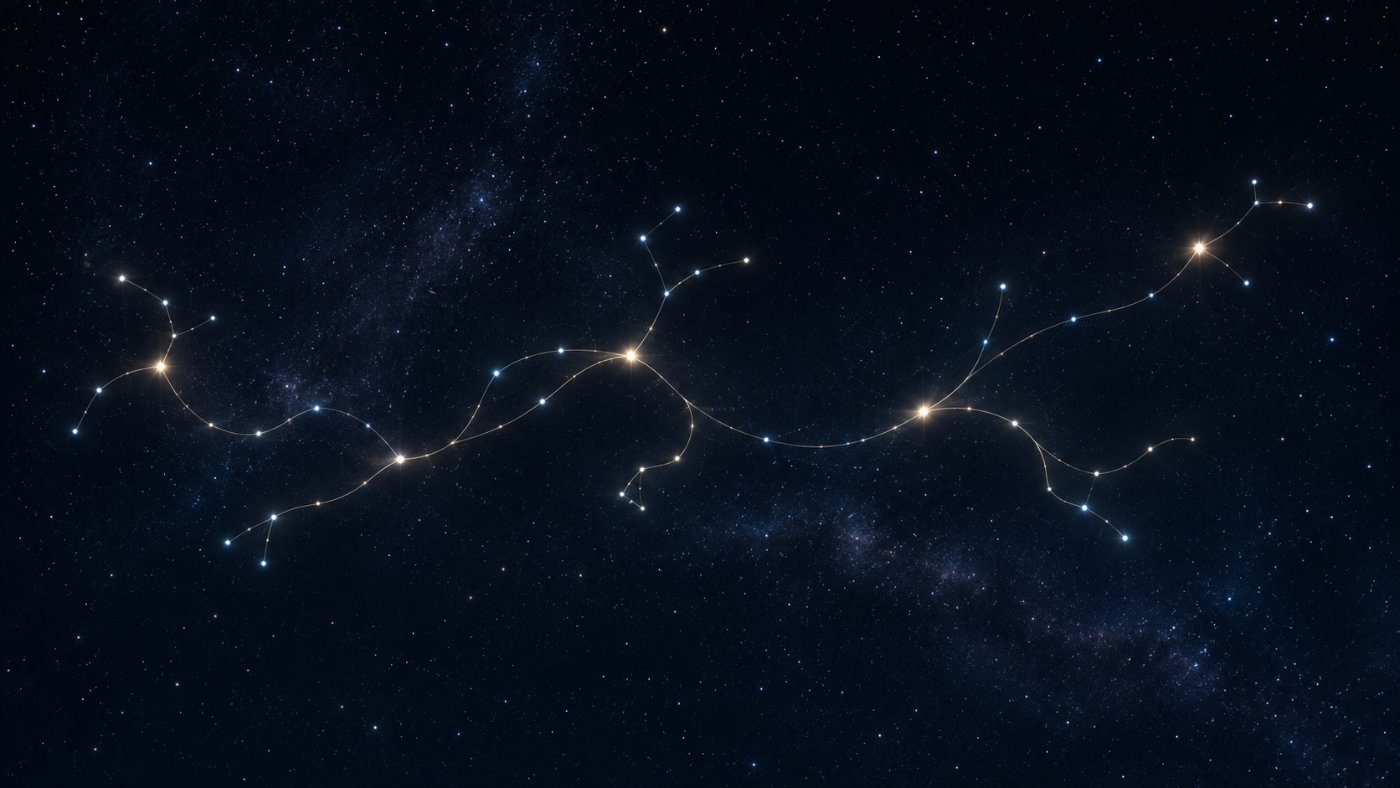
The timeline HOGY envisions is a small universe that lays out family life across time and space.
An item we bought, a meal we shared, a family event, a record of caring for something in the home, a photo from that moment. Each record appears as a small point in time.
An ordinary meal becomes a tiny point of light, and an everyday purchase becomes a star. The day we bought a car or home, a trip or graduation, welcoming a new family member or saying goodbye to someone dear—these remain as points in time that help us trace the flow of life.
The size and shape of each point are visual cues to help distinguish and explore records. A large expense or a striking event is not necessarily more important in life.
A meal may be a small point, but all those meals together carry our family through each day.
From a distance, the records look like a dense cluster of lights. As we move closer, the days we’ve spent eating and living come into view.
Zoom In on Time to Unfold a Day
At first, records from a few months or even years may look like a cluster of stars.
Zoom in, and a month breaks into individual days, revealing the activities recorded within each one. Select a point with a photo, and a small image opens into a larger one, alongside the date and a short story from that time.
Zoom back out, and the photo returns to its original place in time.
It’s an experience of looking at where a moment sits in our family’s timeline, stepping into a memory, and then returning.
Open a child’s birthday, and you may find family photos, the meal from that day, and the things bought while getting ready for the celebration. Open a travel photo, and it may lead to other moments captured on the same trip.
We don’t plan to draw every connection out as lines from the start. Usually, points and photos will be visible; when you select a moment you’re curious about, its related connections will appear.
Where Is the Thing We Bought That Day Now?
Records we follow through time can also lead us into the spaces of our home.
Think of the day you bought dog food and a food bowl. The purchase record tells you when those two things came into your home. Connect them to where they’re stored, and the food leads to the pantry, while the bowl leads to the dog’s eating spot in one corner of the living room.
Even if you move the bowl somewhere else, the date you first bought it remains. And when the food is used up, the purchase record doesn’t disappear.
A single object lets us explore three questions.
When did it come into our home? Where is it now? How have we used it over time?
Places outside the home can also be connected to records. If the transaction time and location are available, the same purchase can be found through both time and place.
In the timeline, it appears as “an afternoon grocery run.” In the place view, it appears as “purchase records from that supermarket.” These connections between places show relationships confirmed by records; they don’t represent an actual travel route.
This is the depth that home ontology brings to the timeline: the ability to explore one record through its many relationships.
We Share the Same Time, but Leave Different Traces
Even when a family lives in the same home, each person’s day is different.
Some people move from one activity to another in the same place, while others spend their day traveling between school, work, and many different locations.
In HOGY’s small universe, we hope to represent each family member as a different light. When records accumulate in one place, light gathers around it; when records are left in many places, traces of activity spread out across a wider area.
From far away, the light may look like one, but zoom in and it separates into different dates and activities. We can see how even a familiar routine in one place contains countless individual days.
Still, the number of records or the area they cover doesn’t tell the whole story of someone’s life. The person who uploaded a photo isn’t necessarily the one at the center of that activity, either. We build a picture of family time based on confirmed relationships showing who was part of each record.
What HOGY hopes to capture is a family shaped by the coming together of different days.
The Joy of Revisiting Small Traces
We’re creating this space so the records we make in everyday life can become stories we want to revisit.
Connect a photo, and that moment appears in time. A meal record becomes a small light in the day, while a record of caring for an object shows the time we’ve spent with it.
If the traces of everyday life could be found together in one place, revisiting our records would become even more enjoyable.
The life of a vegetable garden has its own story, from a photo of the day we planted to the first new leaves and the first harvest. So does a dinner the family prepared together.
It’s okay if a day with fewer records has fewer points. An empty space doesn’t make that day less precious. The timeline shouldn’t be homework that asks us to fill in every moment of life; it should be a place to revisit the moments that remain.
From Time Past to Life Ahead
Records of the past can also help us prepare for what we’ll need in the future.
The date we serviced a car can help us plan its next inspection, and a record of replacing an appliance filter can help us check when it needs attention again. Records of caring for a pet can also connect to future care.
The idea is to distinguish what has already happened from upcoming or recommended schedules, while making it possible to explore them as part of one continuous flow.
We’re also envisioning an experience where you choose the moments you want and weave them into a short video. It’s a family story that moves from a tiny point of light to a photo, passes through many memories, and arrives in the present.
HOGY’s timeline is currently in the process of being created and refined.
What we hope to do isn’t write an epic life story. It’s to bring back the small records left behind in everyday life.
Someday, when we unfold a year of our lives, we hope to see ordinary dinners and small acts of care alongside photos of big trips.
Because our family’s time is made by special days and ordinary ones together.
*Healthier, more meaningful, smarter.*